Electrode Placement and Lead Selection
Proper electrode placement is essential to acquire an accurate ECG record. ECG monitor manufacturers provide safe use instructions that will include electrode placement guidelines specific to their products. Always adhere to your facility policy and procedure when administering any patient care.
The following are some general guidelines when performing an ECG:
- Check the physician order or protocol
- Wash hands when entering patient room and before touching patient
- Identify yourself to the patient and describe the purpose of your presence
- Identify the patient (per policy)
- Describe the procedure: positioning, skin prep, electrode placement and characteristics, also the need for stillness during recording.
- Encourage the patient to ask questions
- Provide privacy
- Choose sites that minimize interference from adipose, muscle movement, bony prominences, avoid non-intact skin
- Skin preparation:
- Remove excess hair from electrode site (electric clippers are preferred over shaving due to abrasion injury associated razor use).
- Inspect the site, skin should be intact, clean, dry, smooth and flat.
- Clean each site with a clean dry gauze pad to remove excess skin oils, skin cells and residue. If skin is excessively oily use soap and water, dry thoroughly. Avoid using alcohol as it can dry the skin and increase impedance.
- Inspect and place electrode. Rub the electrode to ensure proper contact.
- Electrodes should be changed as needed and every 24/36 hours
 Bipolar limb leads
I, II and III
Bipolar limb leads
I, II and III
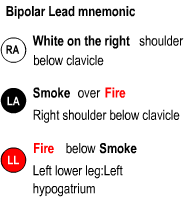
Each bipolar leads has a positive (+) and (-) electrode. Bipolar leads can provide information about the direction and amplitude of a depolarization wave as it propagates through the myocardium.
- A depolarization wave moving toward a (+) electrode produces positive upward deflection on the ECG tracing.
- A wave with a net current movement toward a (-) electrode produces a downward deflection (negative).
- A wave moving perpendicular to the (+) and (-) electrodes will be neutral or flat.
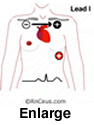 Lead I compares the flow of current between the right arm electrode (-) and the left arm electrode (+). Lead I offers a lateral view of the left ventricle and left atrium.
- Lead II views the left and right ventricles from the apex. It is the most commonly monitored
lead, producing the universally recognized normal sinus rhythm (NSR) tracing. In ahealthy heart, the following electrical activity is depicted in the Lead II NSR tracing
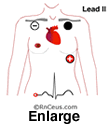 atrial depolarization begins in the sinus node and moves toward the (+) electrode producing the first upright deflection, the P wave.
- Q wave is the first negative deflection below the isoelectric line in the NSR tracing. It is produced as the depolarization wave enters the septum. Upon entering the septum, current flows to the right ventricle at an angle greater than 90o from the (+) electrode which produces the negative deflection.
- R wave amplitude is explained by the nearly instantaneous depolarization of the majority of myocardium. Depolarization is directional from the myocardium toward epicardium and the (+) lead.
- S wave negative deflection represents late phase depolarization of residual myocardium and a small current flow away from the (+) lead.
 The T-wave in Lead II should have a positive deflection. This is because the repolarization process, primarily characterized by the outflow of potassium ions (K+), generates an electrical current that begins in the epicardium at the base of the heart and advances towards the cardiac apex, moving toward the positive electrode of Lead II.
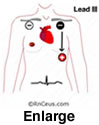
- Lead III provides an inferior view of the right and left ventricles. Lead III along with leads I, II and the unipolar leads aVR, aVL and aVF can be helpful when determining cardiac axis.
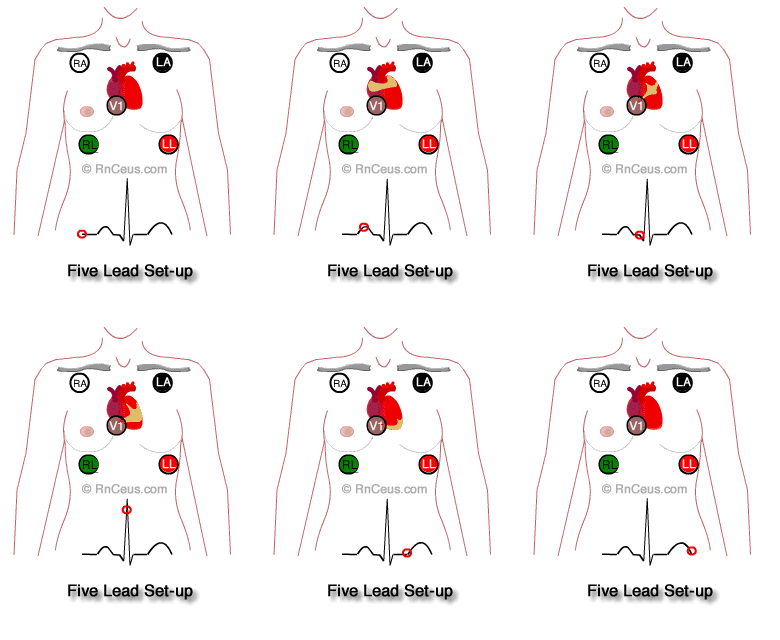
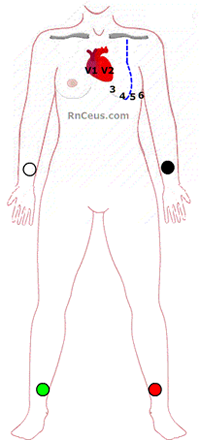
- V1 lead is the best lead to view
ventricular activity including the differentiation of supraventricular tachycardia and ventricular tachycardia. V1 can be viewed with a
five lead system.
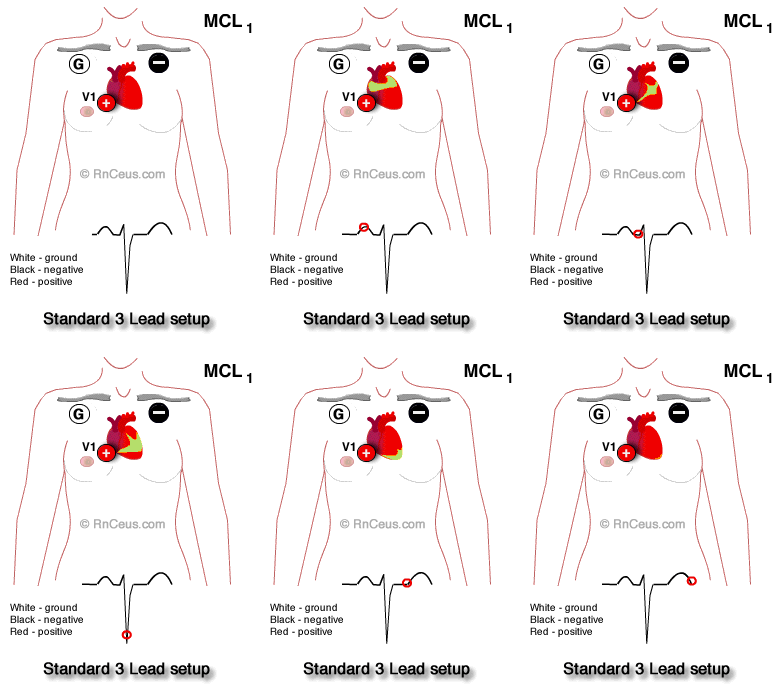
- MCL1 was designed to
overcome the inconvenience of a five lead system
and provide the advantages of V1 viewing.
Trouble shooting and tips
- Change the electrodes everyday.
- Make sure allelectrical patient care equipment is grounded.
- Be sure all the lead cables are intact. Some manufacturers
require changing the cables periodically.
- Be sure the patient's skin is clean and dry.
- Make sure the leads are connected tightly to the electrodes.
- Patient movement frequently causes interference. For example,
the action of brushing teeth may cause interference that mimics V-tach.
References:
Paul, A., & Jacob, J. R. (2023). Electrocardiographic lead reversals. Indian pacing and electrophysiology journal, 23(6), 205–213. https://doi.org/10.1016/j.ipej.2023.09.005
©RnCeus.com